
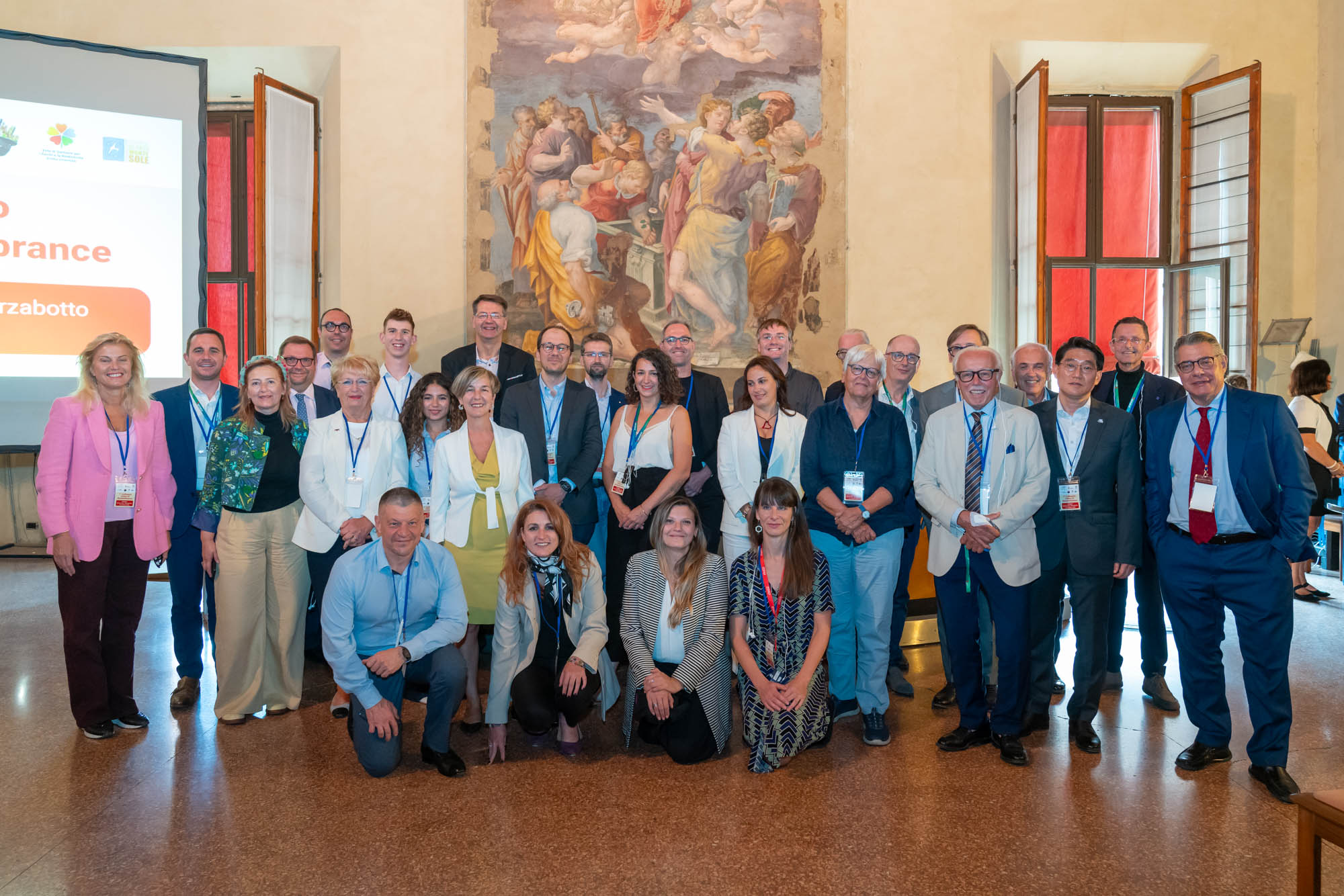
On October 2, 2026, the opening conference of the 7th Cities of Remembrance Symposium brought the Dunkirk Appeal, the Brussels Pledge, and the Nancy Declaration into the same conversation.
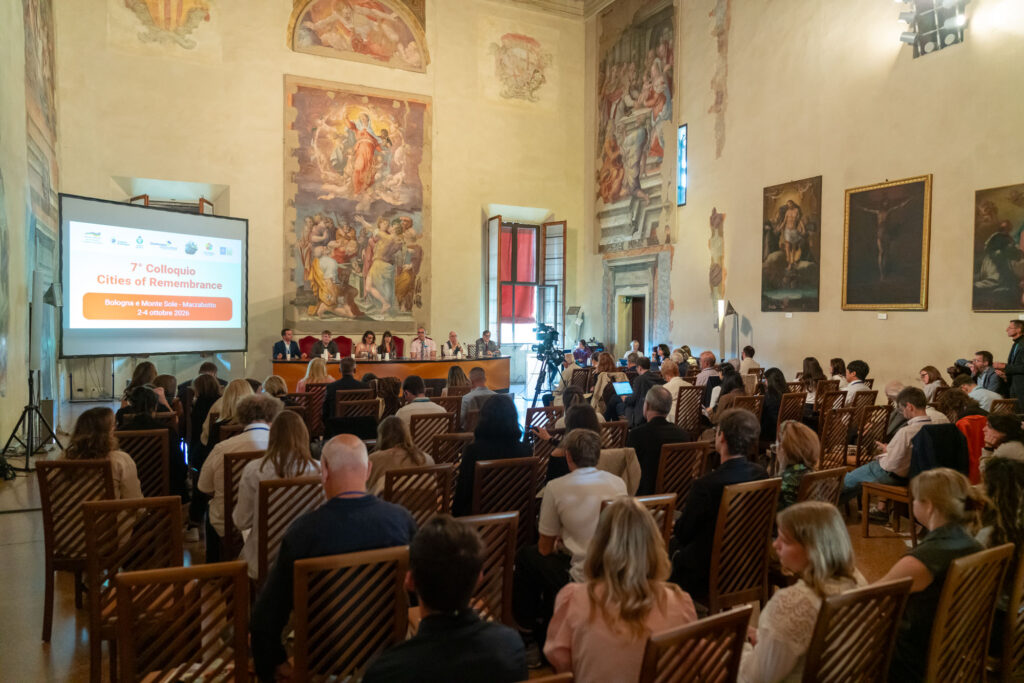
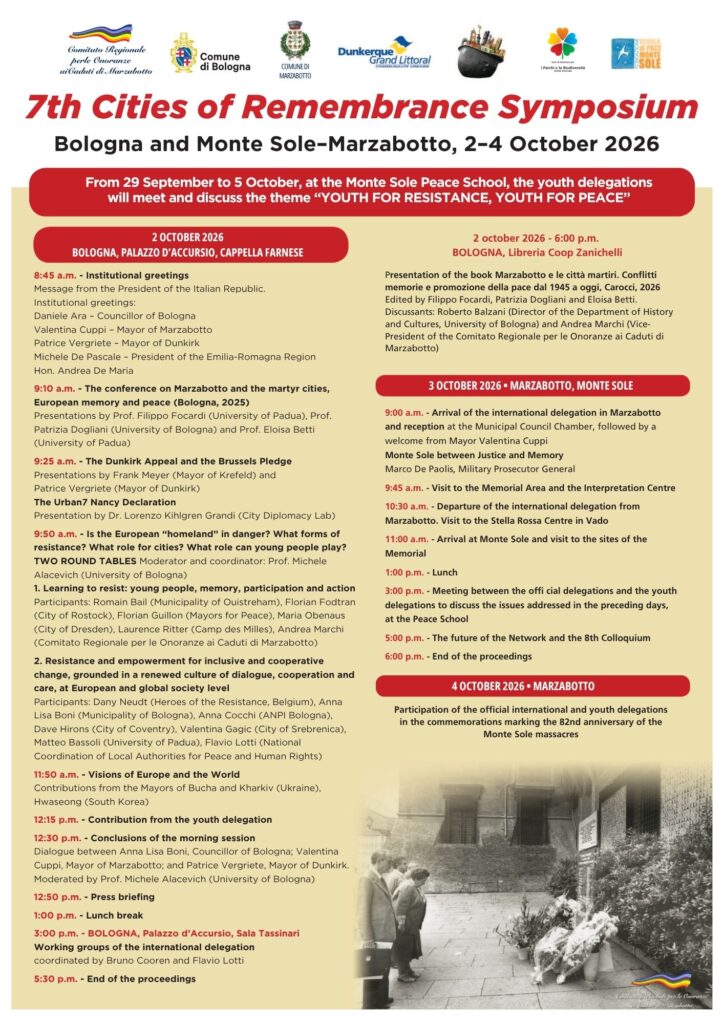
On Friday, October 2, 2026, the 7th Cities of Remembrance Symposium opened in the Cappella Farnese of Palazzo d’Accursio, Bologna’s city hall. The three-day gathering, held in Bologna and Marzabotto, marked the Cities of Remembrance network’s tenth anniversary. The network brings together cities that carry the scars of war, from Dunkirk and Coventry to Marzabotto and Bucha.
The morning session was designed so that three texts could be heard together. Mayor Frank Meyer of Krefeld presented the Dunkirk Appeal, adopted on May 22, 2025. Dr. Patrice Vergriete, Mayor of Dunkirk, spoke about the origins of the network and the Brussels Pledge, adopted on May 7, 2026 at the European Committee of the Regions. Dr. Lorenzo Kihlgren Grandi, Founding Director of the City Diplomacy Lab and Scientific Coordinator of Urban7 2026, presented the Nancy Declaration, the main legacy of the summit. The moderator, Professor Michele Alacevich of the University of Bologna, brought the three speakers and their respective texts into direct dialogue.
A role that goes beyond remembrance
Institutional greetings came from Daniele Ara, Councillor of Bologna, on behalf of Mayor Matteo Lepore; Valentina Cuppi, Mayor of Marzabotto; and Patrice Vergriete, speaking for the network. One idea returned throughout: for cities that bear the marks of war, remembrance is the starting point for action in the present. Cuppi said memory should not be kept as a relic in a display case. She read a message from Italian President Sergio Mattarella, written for the anniversary of the Monte Sole massacres, which warned that what happened can happen again and recalled that peace rests on democracy, participation, solidarity, and justice.
Vergriete traced the network back to the mid-2010s, when a group of mayors realized that peace was more fragile than their generation had assumed. About fifteen cities first met in Dunkirk in 2016 to sound the alarm on nationalism and extremism. He described how Dunkirk has broadened its commemorative focus beyond the 1940 battle to address the rise of fascism in the 1930s, emphasizing the importance of understanding the developments that preceded the war. Democracy alone is no guarantee, he added, since extremist movements can reach power through democratic means; it takes an active humanist culture. “When memory fades, history starts again,” he said, calling it the network’s motto. He described the Brussels Pledge as the moment when the network tied its work to the European project, and announced that the network is now opening to any city that shares its concerns, including cities that were not destroyed in the war.
Meyer started from Krefeld, whose city center was almost entirely destroyed in June 1943, and from a conversation with an eighteen-year-old named Karl, who asked whether his generation would be the first in decades to see war again. Meyer told him he did not know, but that those in office must do everything to prevent it. The Appeal, he explained, looks at the present and the future as much as the past: it commits cities to counter nationalism, populism, and extremism, to defend international law, to stand with cities facing war, and to invest in young people. “It’s a call to action for the future,” he said.
The session also placed the network in a longer history. Historians Filippo Focardi, Patrizia Dogliani, and Eloisa Betti presented Marzabotto e le città martiri (Carocci, 2026), a volume that grew out of a conference held in the same hall exactly one year earlier, with an English edition in preparation. They traced the ties between Marzabotto and other cities that suffered in the war back to the early 1950s, and the creation of the World Union of Martyr Cities in 1982, after a first meeting in Bologna in 1979. The present network, in this light, renews a tradition more than it starts a new one.
Putting the three texts in dialogue
Kihlgren Grandi’s intervention began from a simple claim: Nancy, Dunkirk, and Brussels belong to one coherent and ambitious process, the same one that had brought the room together that morning. In that process, he said, cities build links between things that appear to be opposites, and he named three pairs.
Local and global. Global challenges land first, and hardest, in cities. Cities are also where solutions are born, and from there they travel through direct ties between urban communities, ties that the city representatives attending the symposium embodied.
War and peace. The first section of the Nancy Declaration casts cities as custodians of peace, democracy, and global solidarity amid mounting global pressures. Cities, in their triple identity as spaces, populations, and governments, are now targeted by armed violence, hybrid threats, and cyberattacks. City diplomacy answers with a channel for dialogue that, in the Declaration’s words, “endures well beyond political cycles.”
Past and future. The duty of memory, with its lessons and its wisdom, should become the starting point for the energy and creativity of the next generation. The preamble of the Declaration makes the same link, tying resilience to “the sense of belonging shared across generations” and to investment in young people.
Read side by side, the three texts reveal a shared political ambition: to turn the historical experience of cities into a responsibility for peace, democracy, and international solidarity. The Dunkirk Appeal emphasizes the responsibility of cities marked by past conflicts; the Brussels Pledge connects this commitment to the European project; and the Nancy Declaration brings the international engagement of cities to the G7 agenda, calling for their recognition as custodians of peace and democracy. Together, they point to a common movement in city diplomacy, connecting local experience with wider political and institutional action.
Kihlgren Grandi closed by saying that in Nancy, Dunkirk, Brussels, and Bologna, “we are speaking the same language”: the international engagement of cities, connecting the local and the global, building peace in a world in conflict, and bridging the past and the future. People often say, too lightly, that they stand on the right side of history, he noted, but this time it can be said with conviction, because the cities in the room, with different cultures, populations, and histories, “do carry the same message.”
Voices from the cities
Two round tables followed, on youth engagement and on building inclusive and cooperative change through a renewed culture of dialogue.
Young people as actors, not audience. In Ouistreham, one of the historic landing sites of D-Day on June 6, 1944, schoolchildren take part in commemorative tree-planting ceremonies, with each tree bearing the name of a servicemember who landed that day. In Dresden, a human chain organized by the university and the church, with the city’s organizational support, has circled the city center since 2010 to counter far-right demonstrations and prevent the appropriation of commemorations of the wartime bombing. For the 80th anniversary of the city’s destruction in 2025, Dresden also invited young people from its twin cities instead of their mayors, giving them an active role in the commemorations. In Belgium, the association Heroes of the Resistance organizes “resistance cafés,” where descendants of resistance fighters share their family histories, as well as school activities that connect the history of resistance with the democratic dilemmas young people face today. In Bologna, Deputy Mayor Anna Lisa Boni presented the city’s plans to develop a memory forest and a memory hub on a former railway site. The initiative aims to transform a disused urban space into a place where remembrance, public engagement, and reflection on the past can contribute to shaping the future. Dave Hirons of the Coventry Association for International Friendship argued that peace is won in hearts and minds, and that the network must reach young people where they get their information. His association has committed to developing an exchange program with a youth center in Coburg, and he came to Bologna to revive the twinning between the two cities, which dates back to 1960. The youth delegations that had been meeting at the Monte Sole Peace School since September 29 reported at the end of the morning. One young delegate told the room that memory is not a static monument carved in stone, but a responsibility to carry forward every day.
Visions of Europe and the world. The session brought together representatives of two Ukrainian cities, Bucha and Kharkiv, and the South Korean city of Hwaseong, each offering a distinct perspective on the relationship between historical memory, conflict, and democratic values. Bucha’s deputy mayor drew a parallel between the wartime suffering of Marzabotto and the more recent experience of Bucha, emphasizing the importance of documenting crimes and preserving the memory of their victims. Kharkiv, a Ukrainian Hero City located about 60 kilometers from the Russian border, has established 24 underground educational facilities, including metro schools and protected learning spaces, enabling children to continue attending classes despite ongoing attacks. Its partnership with Bologna, established in 1966, was renewed in July 2026. Hwaseong’s representative reflected on the city’s efforts to connect the memory of Korea’s independence movement with present-day values through education and international exchange.
The experiences shared by the cities represented at the symposium illustrated that remembrance need not remain confined to commemorations or memorial sites. Through city diplomacy, it can also inspire political engagement, strengthen ties across borders, and help younger generations understand their role in safeguarding peace and democratic values. From Dunkirk to Brussels and Nancy, the determination is to turn this shared commitment into lasting cooperation and concrete action.
Students from the City Diplomacy course taught by Dr. Lorenzo Kihlgren Grandi at Johns Hopkins SAIS Europe in Bologna also attended the conference. This semester they are producing a podcast series on the city diplomacy of European capitals, available on the City Diplomacy Student Podcast page.